
A commonly overlooked source of noise in an amplifier is the potentiometer used for the volume control. I’ve seen several designs with a potentiometer with a too high value. The high value doesn’t load the previous stage too much – that’s positive. But it introduces too much noise in the next stage. The amount of noise that is injected, depends on the position of the slider: the worst position is halfway the resistance-value. But that is the position just before max volume.
How about that?
A model for the noise contribution
First a simple model of the volume control:
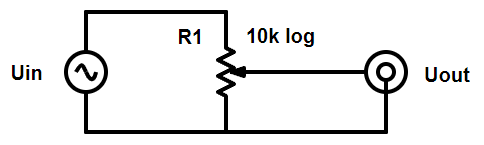
- The voltage source Uin models the input signal.R1 is the potentiometer.
- Normally it is a logarithmic one. Here, by example, is has a value of 10k.
- The output signal can be measured as Uout.
In this model, no noise sources are depicted. But in reality there are two of them. We model them in two steps:
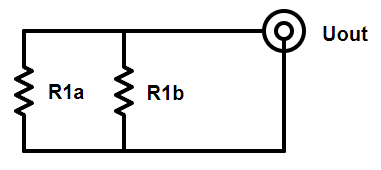
In the first step (figure 2) we have removed the input voltage source because it can be seen as a zero impedance when no signal is applied.
Then the potentiometer is split in two separate resistors R1a and R1b which model the parts of the potentiometer above the slider and beneath the slider. Both resistors add up to 10k – of course.
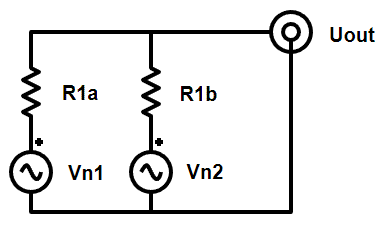
The next step (figure 3) models the noise generated by the resistors is modelled as two independent signal sources Vn1 and Vn2.
You should be aware of the fact that the amplitude of the thermal noise produced by a resistor R is proportional to the value of R. In formula form:
Vn=√(4⋅R⋅k⋅T⋅ΔF)
Where:
- Vn is the RMS noise signal in volts,
- R is the resistance in ohms,
- k is Boltzmann’s constant,
- T is the temperature in Kelvin,
- ΔF is the bandwidth in Hz.
Observations
When the slider is in one of its extreme positions (volume = off or volume = max) one of the resistors R1a and R1b is zero. That means that that resistor does not contribute any noise AND it connects the slider to ground.
Ergo: the potentiometer injects zero noise when the slider is in an end-position.
When the slider is somewhere in the middle, the noise measured at Uout consists of the addition of both Vn1 and Vn2 but each divided by the ratio of R1a and R1b.
The question is now: in which slider position has the noise its maximum value?
We can find the answer to this question quite easily when we notice that the circuit is symmetrical. That gives enough evidence to assume that noise is maximal when R1a =R1b thus when the slider is in the middle position. And with some math you can prove that is true.
NB: because a potentiometer for volume control in audio systems is always logarithmic, the middle position of the slider in terms of resistance is not halfway the rotation of the knob! It is where the knob is nearly at the end, just before maximum volume.
Experiment
I tested this theoretical approach with my own headphone amplifier. It has a potentiometer connected to its input terminals instead of R1 in the schematic. At a quiet moment, late in the eveneing, I shortcircuited the inputs, put on my headphone and listened carefully while rotating the volume knob. And indeed, at a certain position some noise was audible and it reached its maximum just before maximum volume.

Recommendation
Because noise is proportional with the resistance, choose for your volume control a potentiometer with a low value. Not too low because the previous stage must be able to handle the load. But as low as possible.
Choose for your volume control a potentiometer with a value as low as possible.
And now the maths
No maths needed! OK, when you start with figure 3 and use superposition to calculate the effect of both noise sources on Vout, add them squared and rooted, you will find some function from with you can find the maximum value by setting the first derivate to zero etc.
However, it is much easier to start with figure 2 keeping in mind that R1a an R1b can be replaced by an equivalent
Req = R1a || R1b
This equivalent resistor has a corresponding noise voltage and we can draw figure 4:
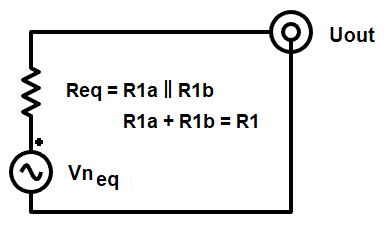
Knowing that Req is always smaller than the smallest of the two parallel resistors, it’s maximum value is reached when R1a = R1b. That’s the situation in which the slider is halfway!
When R1a = R1b, Req = R1a/2. And while R1a = R1b = 1/2 R1, we can conclude:
Req = R1 / 4
Now we have also the value of the noise contribution in that case:
Vn[max]=√(R1⋅k⋅T⋅ΔF)
In figure 1 R1 = 10k. For the audio frequence range 20kHz and at room temperature, Vn[max] will be:
Vn[max] = 910nV (6.4nV/ √ Hz)
That’s already quite high! Imagine a common value of 100K which and the noise will be even a factor √ 10 higher! Compare this for instance with an opamp like OP27 which has a input noise voltage of ~3nV/ √ Hz.
Conclusion
The noise of the potmeter in the volume control can not be neglected!
Samenvatting NL
De ruis die wordt toegevoegd door een potmeter is maximaal wanneer de loper halverwege staat. De ruis is dan gelijk aan die van een weerstand met een kwart van de waarde van die van de potmeter.